


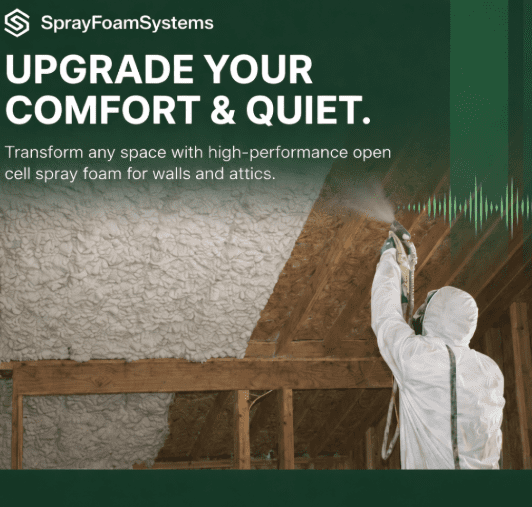
Open cell spray foam continues to grow in popularity for residential and light commercial insulation projects. Contractors choose it because it improves comfort, reduces noise, and supports long-term energy performance. When applied correctly, it becomes a key part of any attic and wall insulation guide focused on efficiency and indoor comfort.
Open cell foam expands quickly after application. As a result, it fills gaps, seals cracks, and creates a continuous insulation layer. This performance makes it an important solution in any attic and wall insulation guide designed for modern building standards.
Why Open Cell Spray Foam Works So Well
Open cell foam uses a lighter-density formula than closed cell foam. Because of its structure, it remains flexible after curing. That flexibility helps it adapt to building movement over time.
In both walls and attics, open cell spray foam provides:
• Effective air sealing to reduce drafts
• Sound dampening between rooms and floors
• Consistent coverage inside irregular cavities
• Reduced energy loss through the building envelope
For contractors following an attic and wall insulation guide, these benefits directly impact homeowner satisfaction and long-term performance.
Improving Comfort in Attics
Attics often allow the greatest amount of heat gain and heat loss. During summer, hot air collects at the roofline. During winter, warm indoor air rises and escapes. Open cell foam addresses both issues by creating an air seal at the roof deck or attic floor.
Unlike traditional loose-fill insulation, spray foam bonds directly to surfaces. Therefore, it reduces uncontrolled air movement. When used as part of a complete attic and wall insulation guide, this approach improves indoor temperature consistency across the entire home.
Additionally, open cell foam helps manage moisture vapor movement. While it remains vapor permeable, it still limits bulk air transfer. This balance supports healthier attic environments.
Enhancing Wall Sound Control
Interior wall cavities play a major role in sound transmission. Open cell spray foam absorbs airborne noise more effectively than many traditional materials. As a result, it reduces sound transfer between rooms, offices, and multi-family units.
For contractors reviewing an attic and wall insulation guide, sound control often becomes a selling point. Bedrooms, media rooms, and shared living spaces benefit greatly from open cell insulation in walls.
Proper installation for walls remains critical for performance. By following proven installation methods, contractors ensure consistent density and full cavity coverage.
Energy Efficiency Benefits
Energy efficiency remains one of the strongest reasons to choose open cell spray foam. Because it seals air leaks, HVAC systems operate more efficiently. Consequently, homeowners experience lower utility costs and improved indoor comfort.
When comparing materials in an attic and wall insulation guide, air sealing ability often outweighs raw R-value alone. Open cell foam delivers both insulation and air control in one step.
Equipment and Material Considerations
Professional spray foam equipment ensures proper temperature control and spray pattern consistency. Accurate mixing and pressure settings allow open cell foam to expand correctly and cure evenly.
Using high-quality open cell foam materials supports better yield, smoother application, and predictable results.
Long-Term Performance and Flexibility
Buildings expand and contract over time. Because open cell foam remains slightly flexible, it adapts to movement without cracking. That durability makes it a reliable recommendation in any attic and wall insulation guide focused on longevity.
Furthermore, open cell foam adds minimal structural weight. Therefore, it works well in retrofit projects and existing structures where weight considerations matter.
FAQs
How does open cell spray foam improve comfort in attics?
It creates an air seal that reduces heat transfer and limits drafts, improving temperature consistency throughout the home.
Is open cell foam good for interior wall sound control?
Yes. Its soft structure absorbs sound waves, reducing noise transfer between rooms and floors.
Where can I find more details in an attic and wall insulation guide?
You can reference our full attic and wall insulation guide along with our detailed installation for walls resource to better understand best practices and performance expectations.
About Spray Foam Systems
Spray Foam Systems is the #1 spray foam rig builder and spray foam equipment supplier in the United StatesFamily-owned and proudly serving the industry since 2007, we operate from a 7-acre campus with over 80,000 square feet of dedicated working space in Greensboro, GA. With over 10,000 customers served over the last 18 years, we specialize in delivering high-quality turnkey spray foam systems, distributing top-tier equipment and supplies, and providing nationwide service and training to help contractors grow and succeed in the spray foam insulation and roofing markets.