


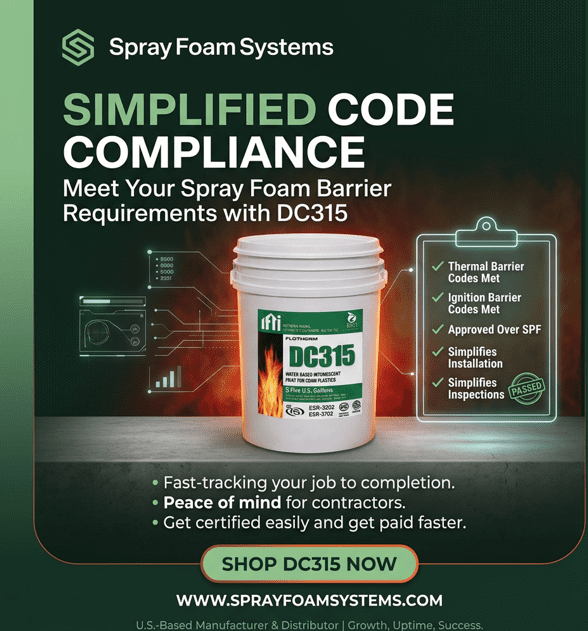
Spray foam insulation delivers strong performance, but code compliance is just as critical. Because spray foam is classified as a foam plastic, building codes require it to be protected by either a thermal or ignition barrier in many applications. Understanding these requirements helps contractors avoid failed inspections and costly rework. DC315 is widely used to help meet these code requirements when applied correctly within approved systems.
Why Code Compliance Matters for Spray Foam Insulation
Spray foam insulation creates an air seal and improves energy efficiency. However, exposed foam must be protected to reduce fire risk. Building codes require a barrier between the foam and occupied or certain concealed spaces.
Contractors who understand these requirements can move through inspections faster and complete projects with confidence. DC315 is commonly used to help meet these requirements in both residential and commercial applications.
What the Building Codes Require
The primary code sections for spray foam insulation are:
- IBC Section 2603.4
- IRC Section R316.4
These sections require foam plastic insulation to be separated from interior spaces by a thermal barrier unless a tested alternative is used. This rule applies to most projects and serves as the baseline requirement for compliance.
Because of this, contractors must always determine whether a thermal barrier or an approved alternative applies before installation. DC315 is often used within approved systems to help meet these code requirements.
What Is a Thermal Barrier
A thermal barrier is designed to protect occupied spaces by slowing heat transfer during a fire. It provides a minimum level of fire resistance that helps delay ignition.
Thermal barriers are required in:
- Living spaces
- Basements
- Garages
- Finished interior areas
Drywall is the most common thermal barrier. However, coatings like DC315 can be used as part of an approved thermal barrier system when applied at the correct thickness and over compatible spray foam insulation.
What Is an Ignition Barrier
An ignition barrier provides a lower level of protection and is used in areas that are not regularly occupied.
Ignition barriers are typically used in:
- Attics
- Crawl spaces
- Service-only areas
These areas allow alternative protection methods. DC315 is widely used as an ignition barrier coating when applied according to approved assemblies.
Thermal Barrier vs Ignition Barrier
Understanding the difference between these two barriers is essential for compliance.
- Thermal barriers are required in occupied spaces
- Ignition barriers are used in limited-access areas
- Thermal barriers provide higher fire protection
- Ignition barriers are faster and easier to install
Because of these differences, contractors must confirm which requirement applies before starting a job. Using DC315 in the correct application helps ensure compliance.
How DC315 Meets Code Requirements
DC315 is an intumescent coating designed to expand when exposed to heat. This expansion creates a protective char layer that helps slow flame spread.
The product is identified as an intumescent fire-resistant coating
When applied correctly, DC315 can help meet ignition barrier requirements and certain thermal barrier requirements. However, it must always be used within tested and approved systems.
To meet code requirements, contractors must ensure:
- Proper application thickness
- Correct coverage rates
- Compatible spray foam materials
- Approved assembly conditions
Following these steps helps ensure DC315 performs as intended and passes inspection.
Important Code Compliance Considerations
Many contractors assume that applying a coating automatically meets code requirements. However, compliance depends on the full system, not just the product.
Key considerations include:
- Not all areas qualify for ignition barriers
- Thermal barriers are still required in occupied spaces
- DC315 must match tested assemblies to be compliant
- Inspectors rely on approved systems, not just product type
By understanding these factors, contractors can avoid common mistakes and complete projects efficiently.
Why Contractors Choose DC315
DC315 is widely used because it simplifies compliance while improving jobsite efficiency.
- Helps meet thermal and ignition barrier requirements when used correctly
- Reduces the need for additional materials in some applications
- Saves time during installation
- Provides consistent coverage with proper application
- Works with many spray foam insulation systems
Using DC315 allows contractors to stay productive while meeting code requirements.
FAQs
What is DC315 used for in spray foam insulation?
DC315 is used as an intumescent coating to help meet thermal and ignition barrier requirements over spray foam insulation when applied within approved systems.
When is a thermal barrier required for spray foam insulation?
A thermal barrier is required in occupied spaces such as living areas, basements, and garages to provide fire protection over spray foam insulation.
Can DC315 be used as an ignition barrier?
Yes, DC315 is commonly used as an ignition barrier in attics and crawl spaces when applied correctly and in accordance with approved assemblies.
About Spray Foam Systems
Spray Foam Systems is the #1 spray foam rig builder and spray foam equipment supplier in the United States. Family-owned and proudly serving the industry since 2007, we operate from a 7-acre campus with over 80,000 square feet of dedicated working space in Greensboro, GA. With over 10,000 customers served over the last 18 years, we specialize in delivering high-quality turnkey spray foam systems, distributing top-tier equipment and supplies, and providing nationwide service and training to help contractors grow and succeed in the spray foam insulation and roofing markets.