


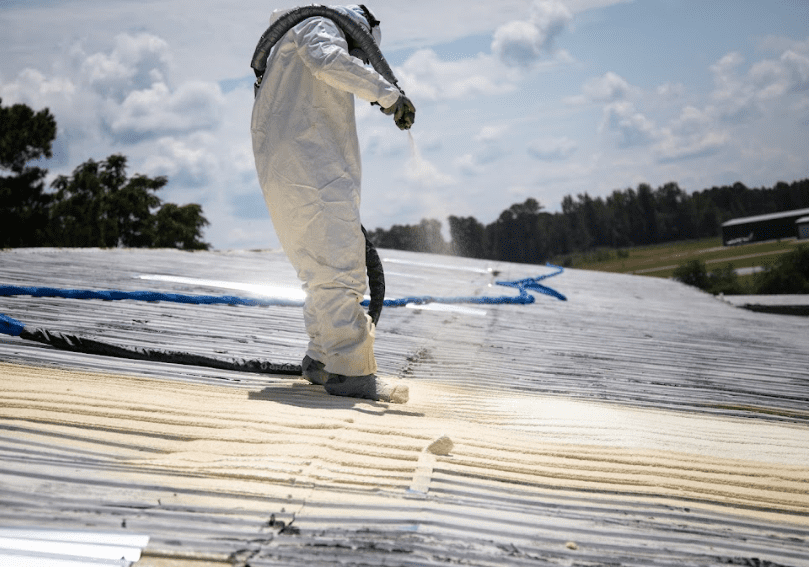
Spray foam roofing systems continue to grow across commercial and industrial markets because they combine insulation and waterproofing into one seamless application. When installed correctly, these systems improve energy efficiency, stop leaks, and extend roof life. However, long-term success depends heavily on the equipment used. A properly configured spray foam machine ensures correct mixing, steady heat, and consistent output across the entire roof surface.
What Is a Spray Foam Roofing System?
A spray foam roofing system uses closed-cell polyurethane foam applied directly over an existing substrate. The foam expands on contact, fills gaps, and forms a continuous insulated layer. After curing, contractors apply a protective coating to guard against UV exposure and weather.
Because the system has no seams or fasteners, it reduces common failure points found in traditional roofing assemblies. As a result, building owners gain improved insulation value and added structural reinforcement.
Why a Spray Foam Machine Is Critical for Roofing
Roof applications require tight control over material temperature and pressure. If either setting fluctuates, foam quality can suffer. A high-performance spray foam machine maintains the proper 1:1 ratio between A and B materials while stabilizing heat and pressure.
This control ensures:
- Uniform cell structure
- Proper adhesion to the substrate
- Correct foam density
- Reduced risk of off-ratio material
When the spray foam machine operates within manufacturer specifications, contractors produce consistent foam that performs for decades.
Proportioners Commonly Used for Roofing Projects
Roofing contractors typically rely on professional-grade proportioners designed for higher output and longer hose runs. These systems provide the power and control needed for large commercial surfaces.
Common proportioners used in roofing applications include:
Electric proportioners such as the Reactor 3 E-30 and E-XP2 offer precise digital controls and strong output for most commercial roofs. Hydraulic models like the H-30 provide additional durability and sustained performance for high-demand projects or extended spray times.
Selecting the right spray foam machine depends on roof size, environmental conditions, and daily production goals.
Heat and Pressure Stability Improve Longevity
Closed-cell roofing foam requires consistent pre-heating to achieve the proper viscosity before application. If temperature drops, the foam may not expand correctly. If pressure becomes unbalanced, mixing can suffer.
Modern proportioners allow contractors to monitor settings in real time. This feature helps maintain consistent output even when outside temperatures change throughout the day. Stable operating conditions lead to better foam density, improved compressive strength, and stronger adhesion.
In roofing, consistency equals longevity.
Uniform Application Across Large Roof Surfaces
Commercial roofs often cover thousands of square feet. Therefore, equipment reliability directly affects project efficiency and finished quality.
A dependable spray foam machine allows contractors to:
- Maintain consistent spray thickness
- Build proper slope for drainage
- Achieve target R-values
- Reduce material waste
Uniform coverage prevents weak spots that could allow moisture intrusion later. Over time, this consistency protects the building envelope and reduces maintenance costs.
Efficiency and Production on Roofing Jobs
Roofing contractors must balance speed with quality. High-output proportioners support continuous spraying and longer hose lengths, which reduces repositioning and downtime.
Reliable equipment improves workflow while protecting foam integrity. When the spray foam machine operates efficiently, crews can complete larger projects without sacrificing performance.
Maintenance and Proper Operation
Routine inspection and calibration remain essential for roofing success. Contractors should regularly check heaters, pumps, filters, and seals to maintain proper material ratio. Clean equipment prevents cross-contamination and protects long-term foam performance.
Proper operator training also ensures correct startup and shutdown procedures. A well-maintained spray foam machine delivers consistent results from the first pass to the final coating layer.
Equipment Selection Directly Impacts Roof Performance
Spray foam roofing systems provide insulation, waterproofing, and air sealing in one seamless layer. However, equipment quality determines whether that system performs as intended. The spray foam machine influences foam density, adhesion strength, and overall durability.
By selecting the correct proportioner and maintaining stable operating conditions, contractors can deliver roofing systems built for long-term protection and energy efficiency.
FAQs
Why is a spray foam machine important for roofing applications?
A spray foam machine controls heat, pressure, and material ratio. Proper control ensures correct foam expansion, adhesion, and long-term roof durability.
Which proportioners are commonly used for spray foam roofing?
Contractors often use the Graco Reactor 3 E-30, Reactor 3 E-XP2, Reactor 2 H-30, and Reactor 3 H-30 for commercial roofing projects.
Can incorrect equipment setup shorten roof lifespan?
Yes. Off-ratio foam or unstable temperatures can create weak adhesion and inconsistent density, which may reduce system longevity.
About Spray Foam Systems
Spray Foam Systems is the #1 spray foam rig builder and spray foam equipment supplier in the United States. Family-owned and proudly serving the industry since 2007, we operate from a 7-acre campus with over 80,000 square feet of dedicated working space in Greensboro, GA. With over 10,000 customers served over the last 18 years, we specialize in delivering high-quality turnkey spray foam systems, distributing top-tier equipment and supplies, and providing nationwide service and training to help contractors grow and succeed in the spray foam insulation and roofing markets.