


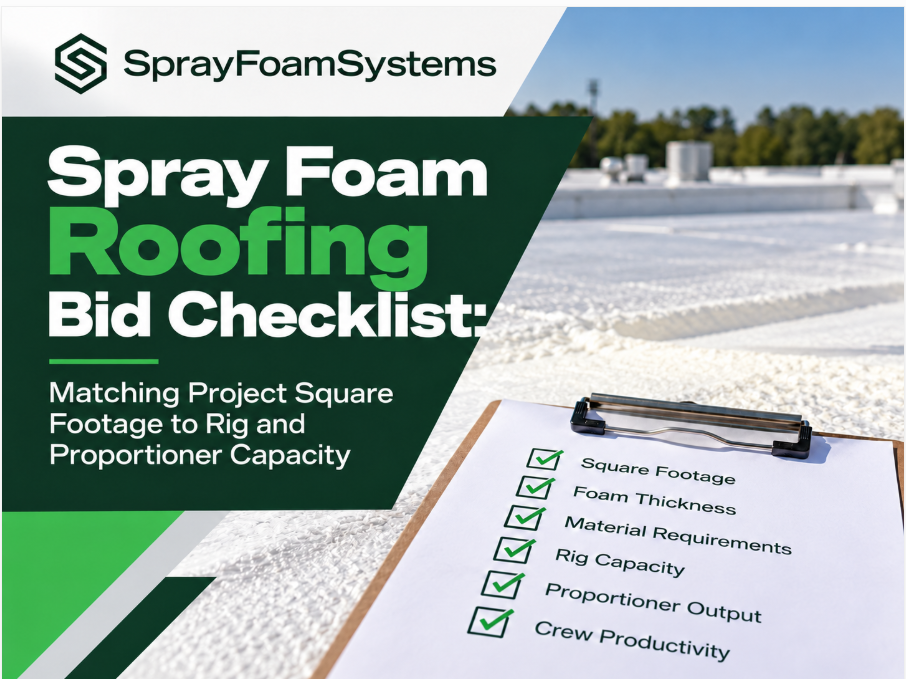
Preparing an accurate spray foam roofing bid requires more than measuring roof square footage. Contractors must also consider foam thickness, material requirements, equipment output, and crew productivity. Matching these factors to rig and proportioner capacity helps contractors estimate project timelines, control costs, and avoid unnecessary downtime.
Start with Accurate Roof Measurements
Before preparing a roofing bid, determine the total area that requires coverage. Roof dimensions provide a starting point, but additional details can affect material usage and application time.
Review these factors during your initial assessment:
- Total square footage: Measure the complete application area, including relevant vertical surfaces.
- Roof conditions: Identify penetrations, drains, curbs, and other obstacles.
- Required foam thickness: Confirm the specified insulation thickness and applicable project requirements.
- Surface preparation: Account for cleaning, repairs, masking, and priming when needed.
These details help establish realistic material estimates and production expectations.
Calculate Material Requirements Before Selecting Equipment
Roof square footage alone does not determine how much spray foam a project requires. Contractors must also calculate the specified thickness and account for application conditions.
For example, a 10,000-square-foot roof requiring two inches of foam represents 20,000 board feet of theoretical coverage.
However, actual material consumption can vary based on substrate conditions, application technique, waste, and the foam manufacturer’s published yield.
Use these calculations to estimate material quantities before determining whether your current equipment can support the project.
Match Proportioner Output to Spray Foam Roofing Project Size
A reliable spray foam roofing estimate should account for the production capabilities of the proportioner.
Consider the following equipment specifications:
- Maximum output: Review the proportioner’s rated material delivery capacity.
- Pressure capabilities: Confirm that operating pressures meet the material manufacturer’s requirements.
- Heating capacity: Verify that the system can maintain appropriate material temperatures.
- Hose length: Determine whether the heated hose can reach application areas without compromising performance.
Higher-output proportioners may benefit contractors working on larger roofing projects. However, actual production depends on operating conditions, material specifications, and the complete equipment setup.
Evaluate Spray Foam Rig Capacity and Jobsite Requirements
The proportioner is only one component of a productive roofing operation. Contractors should also evaluate the complete spray foam rig before committing to a project schedule.
Key considerations include:
- Generator capacity: Confirm sufficient power to support the equipment’s electrical requirements.
- Air compressor output: Verify adequate capacity for spray gun operation and supporting equipment.
- Material staging: Plan drum placement, material access, and replenishment to reduce interruptions during application.
- Transfer pumps: Confirm material delivery capabilities match the proportioner’s requirements.
- Heated hose configuration: Evaluate hose reach and jobsite accessibility.
- Crew productivity: Consider crew size, experience, and expected application efficiency.
A properly configured rig and organized material staging area help maintain consistent workflow throughout the project.
Estimate Production Time and Labor Costs
When developing a spray foam roofing bid, estimate how much material your crew can realistically apply during a typical workday.
Start with the required board footage and an achievable application rate. Then account for setup, material changes, equipment maintenance, and other interruptions.
Weather conditions can also affect production. Temperature, wind, moisture, and unexpected weather delays may limit application windows or require additional preparation. Include potential weather downtime when estimating the project schedule.
Avoid basing your schedule entirely on the proportioner’s maximum rated output. Actual jobsite productivity is often lower because crews must complete preparation, application, inspections, and cleanup.
Final Spray Foam Roofing Bid Checklist
Before submitting your estimate, confirm the following:
- Roof square footage and required foam thickness
- Estimated board footage and material quantities
- Proportioner output, pressure, and heating requirements
- Generator, compressor, and transfer pump capacity
- Heated hose length and roof accessibility
- Material staging, drum placement, and replenishment plans
- Crew productivity and estimated daily output
- Surface preparation, weather considerations, and potential downtime
- Material, labor, equipment, and contingency costs
Completing this checklist helps contractors identify potential production limitations before work begins.
Find the Right Roofing Equipment at Spray Foam Systems
Choosing equipment that matches your spray foam roofing projects can improve productivity and support more accurate estimating.
Spray Foam Systems offers spray foam rigs, proportioners, parts, and equipment support to help contractors prepare for projects of different sizes.
Explore spray foam roofing equipment and rig options at Spray Foam Systems to find a setup that matches your production needs.
FAQs
1. How does roof square footage affect a spray foam roofing bid?
Square footage helps determine the application area, while specified foam thickness establishes theoretical board footage. Contractors must also account for material yield, labor, and equipment capacity.
2. Does a larger roofing project always require a higher-output proportioner?
Not necessarily. Equipment selection depends on production schedules, crew capabilities, material requirements, and available working time. A higher-output system may improve efficiency on larger projects when the complete setup can support it.
3. Can Spray Foam Systems help contractors select roofing equipment?
Yes. Spray Foam Systems offers spray foam rigs, proportioners, parts, and equipment support to help contractors evaluate equipment options based on their roofing applications and production needs.
About Spray Foam Systems
Spray Foam Systems is the #1 spray foam rig builder and spray foam equipment supplier in the United States. Family-owned and proudly serving the industry since 2007, we operate from a 7-acre campus with over 80,000 square feet of dedicated working space in Greensboro, GA. With over 10,000 customers served over the last 18 years, we specialize in delivering high-quality turnkey spray foam systems, distributing top-tier equipment and supplies, and providing nationwide service and training to help contractors grow and succeed in the spray foam insulation and roofing markets.