


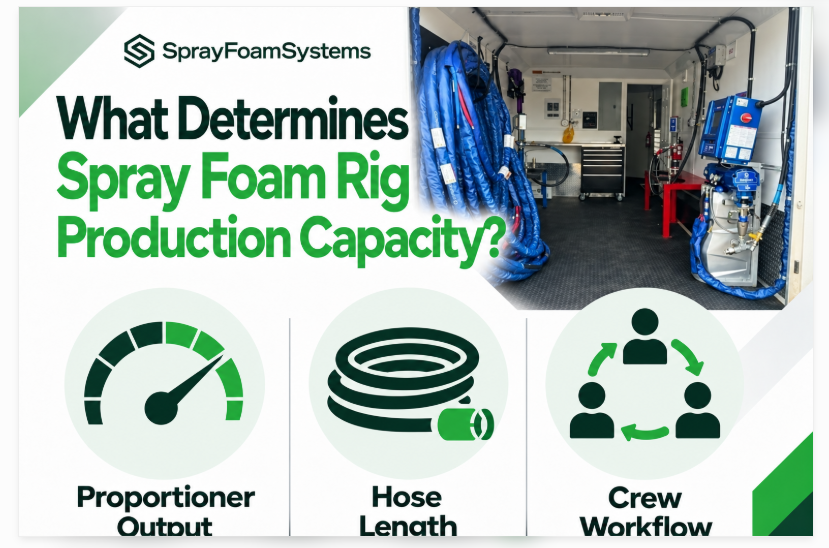
A spray foam rig can only produce as efficiently as its complete system allows. While proportioner output is important, heated hose length, material delivery, spray gun setup, jobsite conditions, and crew workflow all influence how much work contractors can complete in a day.
Understanding how these factors work together can help contractors choose the right equipment and identify what may be limiting production.
How Proportioner Output Affects a Spray Foam Rig
The proportioner establishes one of the primary limits on production. Manufacturers rate proportioners according to factors such as maximum output, operating pressure, and heating capacity.
However, maximum rated output does not mean a spray foam rig will continuously operate at that rate. Actual production depends on whether the rest of the system can properly support the proportioner.
Important factors include:
- Proportioner output
- Primary heater capacity
- Material temperature
- Spray pressure
- Transfer pump performance
- Spray gun and mixing chamber configuration
- Foam manufacturer processing requirements
The goal is consistent delivery of properly heated and proportioned material rather than simply operating at maximum output.
Heated Hose Length and Material Delivery
Heated hose provides the reach contractors need to move throughout a jobsite. However, longer hose runs also require the system to maintain proper material temperature and delivery over a greater distance.
A spray foam rig should have enough hose for the intended projects while staying within the proportioner manufacturer’s recommended configuration.
Material delivery is equally important. Transfer pumps must continuously supply the A-side and B-side materials to the proportioner.
Restrictions can reduce performance, including:
- Clogged filters or screens
- Restricted supply hoses
- Poor transfer pump performance
- Low material levels
- Improper material temperatures
A high-output proportioner cannot maintain production when material cannot reach it consistently.
Spray Gun and Mixing Chamber Configuration
The spray gun and mixing chamber also influence production.
Larger mixing chambers can support greater material flow when paired with equipment capable of supplying that output. However, contractors should match the chamber to the proportioner, material, spray pattern, and application rather than choosing based only on maximum flow.
Every major component of the spray foam rig needs to work together as one system.
Crew Workflow Can Affect Daily Production
Equipment specifications are only part of production capacity. Crew organization can have a significant effect on how much work gets completed during the day.
An efficient workflow may include:
- Keeping drums and materials ready
- Managing heated hose while the applicator sprays
- Preparing the next spray area
- Monitoring material levels
- Handling masking and cleanup efficiently
- Completing equipment checks before spraying begins
If the applicator repeatedly stops to reposition hose, change materials, prepare surfaces, or address preventable equipment issues, overall production drops.
Improving crew workflow can therefore increase practical spray foam rig production without changing the proportioner.
Jobsite Conditions Matter
Production also varies between projects.
Large, open commercial spaces may allow longer periods of continuous spraying. Residential attics, crawl spaces, and other restricted areas may require more movement, preparation, and hose management.
Other factors include:
- Substrate temperature
- Ambient temperature
- Foam formulation
- Required lift thickness
- Ventilation requirements
- Jobsite accessibility
Because conditions vary, contractors should evaluate production based on completed work over the entire day rather than proportioner output alone.
Choosing a Spray Foam Rig for Your Production Goals
Contractors planning for higher production should evaluate the entire system.
The proportioner needs enough output and heating capacity for the application. Transfer pumps must keep material supplied, heated hose needs sufficient reach, and the spray gun must match the equipment and material.
Just as importantly, the crew needs a workflow that keeps the applicator spraying instead of waiting.
When these elements are properly matched, a spray foam rig can deliver more consistent and predictable production from one project to the next.
Spray Foam Systems can help you compare proportioners, hose configurations, transfer pumps, spray guns, and complete spray foam rig packages based on your application and production goals.
FAQs
What determines how much a spray foam rig can produce?
Proportioner output, heating capacity, material delivery, heated hose configuration, spray gun setup, jobsite conditions, and crew workflow all affect actual production.
Does longer heated hose reduce spray foam rig production?
Not necessarily. However, the equipment must be capable of maintaining proper material temperature and delivery throughout the entire hose length.
Should I choose a spray foam rig based only on proportioner output?
No. Contractors should also consider heating capacity, transfer pumps, hose requirements, spray gun configuration, power requirements, application type, and expected crew workflow.
About Spray Foam Systems
Spray Foam Systems is the #1 spray foam rig builder and spray foam equipment supplier in the United States. Family-owned and proudly serving the industry since 2007, we operate from a 7-acre campus with over 80,000 square feet of dedicated working space in Greensboro, GA. With over 10,000 customers served over the last 18 years, we specialize in delivering high-quality turnkey spray foam systems, distributing top-tier equipment and supplies, and providing nationwide service and training to help contractors grow and succeed in the spray foam insulation and roofing markets.