


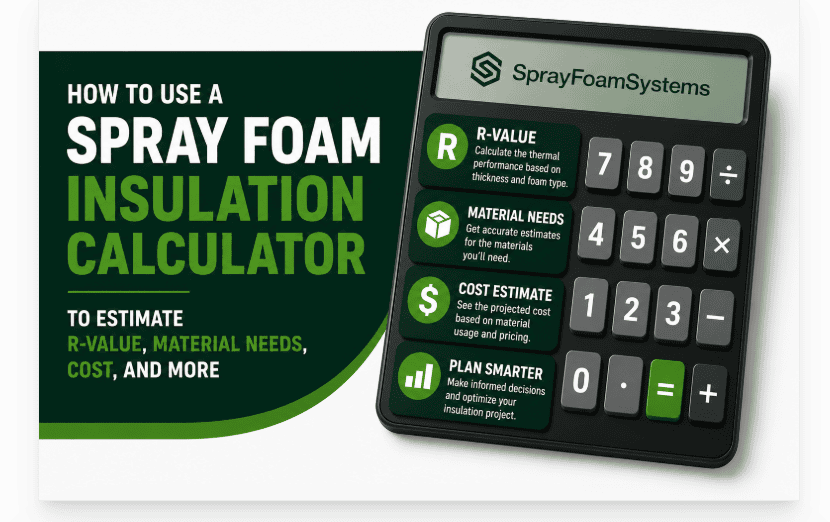
Planning a spray foam project starts with understanding how much material you’ll need and what level of insulation performance you’re trying to achieve. A spray foam insulation calculator helps contractors estimate board footage, project costs, and insulation thickness before work begins.
Knowing the expected spray foam R-value for your project also helps ensure you’re selecting the right foam and applying the correct thickness to meet performance goals.
Why Use a Spray Foam Insulation Calculator?
A spray foam insulation calculator provides estimates that help contractors:
- Determine approximate material requirements
- Estimate project costs
- Calculate required foam thickness
- Compare insulation performance
- Reduce material waste
- Improve job planning and scheduling
While every project has unique conditions, using a calculator creates a reliable starting point before ordering materials.
Understanding Spray Foam R-Value
One of the most important inputs when using a calculator is the desired spray foam R-value. R-value measures an insulation material’s resistance to heat transfer. Higher R-values generally provide greater insulating performance.
Typical factors that influence the final insulation value include:
- Open-cell vs. closed-cell foam
- Installed thickness
- Building location and climate zone
- Wall, roof, or crawl space application
- Local energy code requirements
Understanding your target spray foam R-value helps determine how much foam must be installed for each application.
Estimating Material Requirements
Most spray foam insulation calculators use board feet to estimate material usage.
One board foot equals:
- 12 inches × 12 inches × 1 inch thick
To estimate material requirements, you’ll typically enter:
- Square footage
- Desired foam thickness
- Foam type
- Expected yield
Keep in mind that actual yield can vary based on environmental conditions, application technique, equipment settings, and substrate temperature.
Calculating Project Costs
Material quantity is one of the biggest factors affecting project cost.
A calculator can help estimate:
- Foam material usage
- Chemical consumption
- Waste allowance
- Labor planning
- Overall project budgeting
Although calculators provide estimates, experienced contractors also account for jobsite conditions, equipment setup time, and application complexity.
Using R-Value to Determine Foam Thickness
Once you’ve selected your insulation goals, you can calculate the approximate thickness required to achieve your desired spray foam R-value.
For example:
- Roof decks
- Exterior walls
- Crawl spaces
- Rim joists
- Commercial roofing systems
Each application may require a different insulation thickness depending on code requirements and energy performance objectives.
Understanding insulation performance before beginning a project helps contractors make better estimating decisions and deliver consistent results.
Factors That Affect Calculator Accuracy
A spray foam insulation calculator provides estimates, but several real-world conditions can influence actual material usage:
- Ambient temperature
- Surface temperature
- Humidity
- Equipment calibration
- Spray technique
- Material expansion characteristics
Experienced installers understand that these variables may affect yield and should always allow for reasonable adjustments when ordering materials.
Equipment Matters
Even the most accurate calculations depend on equipment that delivers consistent foam output. Properly maintained proportioners, heated hoses, transfer pumps, and spray guns help contractors achieve uniform application and predictable results.
Spray Foam Systems supplies professional spray foam equipment, replacement parts, accessories, technical support, and contractor training to help installers maximize efficiency and produce consistent insulation performance on every project.
If you’re planning your next insulation project, having reliable equipment along with an accurate calculator can improve estimating, reduce waste, and help you achieve the desired insulation results.
Looking for Professional Estimating Software?
While a spray foam insulation calculator is a great starting point for estimating material needs, contractors looking for more advanced estimating capabilities may benefit from dedicated software. The Pro APP by Estimate Rocket helps spray foam contractors create professional estimates, manage projects, and streamline their sales process from one platform.
If you’re looking for estimating software built specifically for the spray foam industry, consider the Pro APP by Estimate Rocket.
FAQs
What is spray foam R-value?
Spray foam R-value measures the insulation’s resistance to heat transfer. Higher R-values generally provide greater thermal performance when installed correctly.
Can a spray foam insulation calculator determine exactly how much material I’ll use?
A calculator provides a reliable estimate, but actual material usage may vary based on environmental conditions, equipment performance, and installation technique.
Why should contractors calculate spray foam R-value before starting a project?
Calculating the target spray foam R-value helps determine the proper foam thickness needed to meet insulation goals, improve energy efficiency, and satisfy building code requirements.
About Spray Foam Systems
Spray Foam Systems is the #1 spray foam rig builder and spray foam equipment supplier in the United States. Family-owned and proudly serving the industry since 2007, we operate from a 7-acre campus with over 80,000 square feet of dedicated working space in Greensboro, GA. With over 10,000 customers served over the last 18 years, we specialize in delivering high-quality turnkey spray foam systems, distributing top-tier equipment and supplies, and providing nationwide service and training to help contractors grow and succeed in the spray foam insulation and roofing markets.