


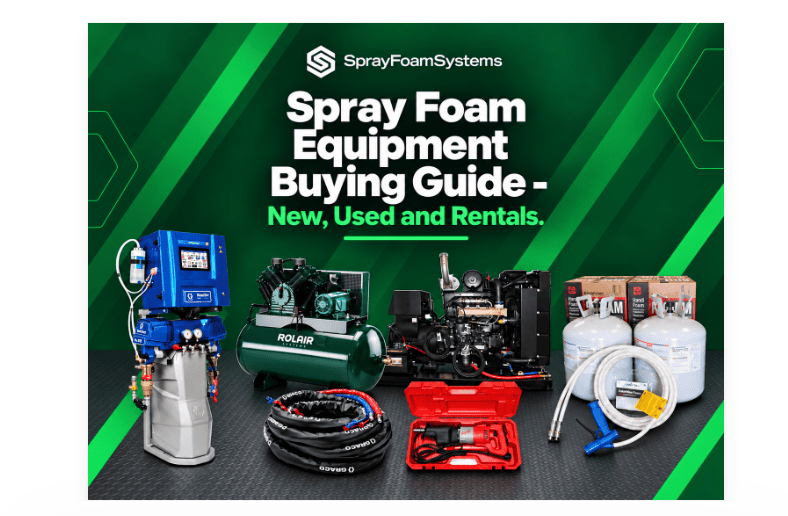
Choosing the right spray foam equipment and supplies starts with matching the system to the type of work you plan to perform. Whether you are buying new equipment, considering used spray foam equipment, or comparing ownership with a short-term rental, the goal is dependable performance, efficient production, and equipment that supports your business long term.
A complete professional setup includes more than the machine itself. Proportioners, heated hoses, spray guns, transfer pumps, an air compressor, a generator, PPE, replacement parts, and access to training and service all contribute to reliable operation.
What Does a Complete Spray Foam Setup Include?
Professional spray foam equipment and supplies work together as one system. Each component has a specific role in moving, heating, metering, and applying material correctly.
A typical setup may include:
- Proportioner: Heats and meters the A-side and B-side materials at the proper ratio.
- Heated hoses: Maintain material temperature between the proportioner and spray gun.
- Spray guns: Mix the materials at the point of application and require regular cleaning and maintenance.
- Transfer pumps: Move material from drums into the proportioner.
- Air compressor: Provides the air needed for compatible spray guns and pneumatic components.
- Generator: Supplies the electrical power required by the system.
- PPE: Includes appropriate respiratory, skin, and eye protection.
- Tools and Supplies: Includes filters, seals, O-rings, lubricants, gun parts, hose protection, and cleaning tools.
The proportioner is the core of most professional spray foam equipment. If it is underpowered, poorly maintained, or not suited to the material being sprayed, contractors may experience pressure problems, poor yield, off-ratio foam, inconsistent application, or downtime.
Choosing the Right Type of Spray Foam Equipment
The right equipment depends on how often you spray, where the work is performed, the material being applied, and the amount of production required.
Portable and Cart-Mounted Systems
Portable systems can work well where mobility is more important than maximum production. They may be suitable for repairs, smaller insulation applications, specialty work, or contractors adding spray foam to an existing service.
Smaller systems may have lower output, heating capacity, pressure, or hose capabilities than larger professional systems. The key is choosing equipment that matches the expected workload.
Spray Foam Rigs
Professional spray foam rigs combine the primary equipment, power, air, chemicals, tools, and supplies into one mobile setup.
Trailer, van, box truck, and other rig configurations can be built for residential insulation, commercial applications, agricultural buildings, roofing, coatings, and other polyurethane applications.
Rig layout also matters. Proper ventilation, adequate power, practical hose access, lighting, and organized replacement parts can help crews work more efficiently.
Turnkey Spray Foam Systems
Turnkey spray foam systems provide contractors with components that are selected to work together. Depending on the package, a system may include the proportioner, air compressor, generator, heated hose, spray gun, transfer pumps, and the trailer, van, or truck configuration.
Before buying a turnkey system, confirm exactly what is included, whether the components match your intended application, what spray foam training is available, and what spray foam equipment service and technical support are provided after the sale.
Buying New Spray Foam Equipment and Supplies
Buying new spray foam equipment and supplies provides a known equipment history and gives contractors the opportunity to select a system around their specific applications and production requirements.
New equipment can be especially valuable for startup contractors who want a properly matched system without sourcing every component individually. Established companies may purchase new equipment to increase output, build another crew, replace older equipment, or expand into another application.
Before choosing a system, consider:
- Application and material requirements
- Expected daily production
- Proportioner output and heating capacity
- Heated hose length
- Generator and electrical requirements
- Air compressor requirements
- Transportation and rig configuration
- Replacement parts availability
- Spray foam training
- Spray foam equipment service
- Future business growth
Purchase price matters, but the equipment also needs to remain practical for the work your company expects to perform.
What Should You Check When Buying Used Spray Foam Equipment?
Used spray foam equipment can provide a lower-cost entry into professional spray foam or help an established contractor add production capacity.
However, price alone should not determine the purchase. A lower-priced system can become expensive if the proportioner requires major repairs, the heated hoses have cold spots, the generator is undersized, or the spray gun requires extensive rebuilding.
Before buying, check:
- Confirm the system is suitable for the application and material you plan to spray.
- Review available maintenance and service records.
- Inspect heated hoses for damage, worn fittings, chemical buildup, and heating problems.
- Check proportioner hours, pressures, heating performance, and previous ratio issues.
- Inspect the spray gun and confirm replacement parts are readily available.
- Verify that the generator and air compressor are properly sized for the system.
- Inspect the overall spray foam rig for ventilation, lighting, hose access, and organization.
- Confirm that replacement parts and service are available.
- Budget for initial service, filters, seals, gun parts, hoses, and transfer pump components.
- Consider training and startup support when changing equipment or entering the spray foam industry.
Whenever possible, see the equipment operate under heat and pressure. A machine that turns on is not necessarily ready for reliable production.
Contractors comparing spray foam equipment from Graco, PMC, Boss , or other manufacturers should consider maintenance history, parts availability, equipment condition, and service support along with the brand and purchase price.
How Rentals Compare With Equipment Ownership
Some contractors may consider spray foam equipment rental for a temporary project, occasional need, or short-term production requirement.
Rental may provide temporary access to equipment without purchasing a complete system, but repeated rental costs, scheduling limitations, and less control over equipment condition can make it less practical for a contractor performing spray foam work regularly.
For companies building a long-term spray foam operation, owning spray foam equipment and supplies provides greater control over scheduling, equipment maintenance, rig configuration, and availability.
Spray Foam Kits vs. Professional Equipment
Spray foam kits can be useful for touch-ups, rim joists, patching, smaller remodels, and other limited applications. They are different from professional insulation equipment designed for repeated production work.
Professional contractors performing residential insulation, commercial insulation, roofing, coatings, or other ongoing applications generally need higher production capabilities and equipment designed for regular use.
Choosing between a kit and professional equipment should be based on job size, required output, frequency of use, material requirements, and the type of work being performed.
Parts, PPE, and Service Matter Too
Even high-quality equipment cannot perform reliably without the proper spray foam equipment and supplies available to support it.
Contractors should consider keeping commonly needed items on hand, including:
- Spray gun rebuild parts
- Filters, screens, seals, and O-rings
- Pump lubricants and throat seal liquid where required
- Hose protection and fittings
- Transfer pump parts
- Disposable suits and gloves
- Eye protection
- Respiratory protection appropriate for the application
- Masking materials, plastic, and tape
- Ventilation equipment
- Spill-control and cleanup materials
Keeping routine replacement parts available can help prevent a minor component problem from stopping an entire job.
Access to a spray foam equipment service center can also be important when troubleshooting goes beyond routine maintenance. Professional service can help contractors address worn components, equipment problems, and repairs that could otherwise lead to extended downtime.
Contractors should also follow product instructions, safety data sheets, applicable regulations, and manufacturer guidance for ventilation, PPE, chemical handling, and application procedures.
Consider the Total Cost of Ownership
The initial equipment price is only part of the investment. Professional systems can range significantly in cost depending on the proportioner, rig configuration, generator, air compressor, hose length, included equipment, and overall build.
Pricing for used spray foam equipment should reflect age, condition, service history, included components, and how much work may be required before the system is ready to spray.
Contractors should also budget for chemicals, replacement parts, PPE, filters, cleaning supplies, training, insurance, transportation, storage, and potential downtime.
A lower-priced system that frequently requires repairs can ultimately cost more than a properly maintained system with a higher initial investment.
Match Spray Foam Equipment and Supplies to Your Business Goals
The right spray foam equipment and supplies should support the type of company you are building and the applications you plan to perform.
Residential insulation contractors should consider dependable heating, appropriate hose length, efficient setup, and enough production for walls, attics, crawlspaces, and rim joists.
Commercial contractors may prioritize higher production, dependable components, readily available replacement parts, and equipment capable of supporting longer spray days.
Roofing and coatings contractors should consider pressure requirements, material compatibility, hose length, and the demands of their specific applications.
Startup contractors should balance budget with training, maintenance, equipment support, and room to grow. Established contractors may need equipment that reduces production bottlenecks, supports an additional crew, or allows the company to enter a new market.
Training is another important part of the investment. Operators need to understand temperature, pressure, substrate conditions, pass thickness, ventilation, chemical handling, troubleshooting, and routine equipment maintenance.
Start by defining your services, expected job size, production requirements, budget, and transportation needs. Then compare spray foam kits, portable systems, new equipment, used spray foam equipment, and turnkey spray foam systems based on those requirements.
Shop spray foam equipment and supplies from Spray Foam Systems for professional equipment, parts, accessories, training, and service support for spray foam contractors.
FAQs
What is the most important factor when choosing spray foam equipment?
The equipment should match your application, expected production, material requirements, power needs, hose length, transportation needs, and long-term business goals.
Is used spray foam equipment a good option for a startup contractor?
Yes. Used equipment can reduce the initial investment when it has been properly maintained. Buyers should evaluate the proportioner, heated hoses, spray gun, generator, air compressor, service history, replacement part availability, and potential repair costs before purchasing.
When might a contractor consider renting instead of buying spray foam equipment?
Rental may be considered for a temporary project or occasional need. Contractors performing spray foam work consistently may benefit more from owning equipment they can maintain, configure, and have available according to their own schedule.
About Spray Foam Systems
Spray Foam Systems is the #1 spray foam rig builder and spray foam equipment supplier in the United States. Family-owned and proudly serving the industry since 2007, we operate from a 7-acre campus with over 80,000 square feet of dedicated working space in Greensboro, GA. With over 10,000 customers served over the last 18 years, we specialize in delivering high-quality turnkey spray foam systems, distributing top-tier equipment and supplies, and providing nationwide service and training to help contractors grow and succeed in the spray foam insulation and roofing markets.