



The construction season doesn’t always align with perfect weather. Projects often drag into the colder months, leaving you with a critical question: Should you apply urethane insulation in winter? The short answer is yes, you certainly can. However, the process requires more preparation and stricter adherence to specific application protocols than summer jobs.
Winter jobs present unique challenges involving substrate temperature, ambient air conditions, and chemical viscosity. If you ignore these variables, you risk poor yields, off-ratio foam, and adhesion failures that could cost thousands in callbacks and repairs.
The Chemistry of Cold Weather Applications
Cold-weather applications present unique challenges that demand a thorough understanding of chemical behavior under low temperatures.
Thermal Loss and Yield Impact
Polyurethane foam relies on an exothermic reaction. When the A-side (isocyanate) and B-side (resin) mix, they generate heat, which causes the foam to expand and cure. Cold environments actively work against this process. Low temperatures act as a heat sink, removing thermal energy from the reaction before the foam has a chance to properly rise and cross-link.
Viscosity Challenges
Cold chemicals become thick and syrup-like, or more viscous. This thickening places immense strain on your proportioner pumps (equipment that controls the ratio and flow of the two chemical components) and can hinder the mixing process in the gun.
If the chemicals are too cold, they will not mix thoroughly at the impingement point, which is where the two components meet and blend. This results in an off-ratio mix that is chemically unstable and potentially hazardous. Therefore, temperature management starts long before you pull the trigger.
Managing Equipment and Chemical Storage
Properly managing your equipment and chemical storage is vital to ensuring consistent performance, safety, and efficiency. Without a strategic approach, your materials and tools are at risk of degradation, potentially compromising the entire operation.
Chemical Storage Tips
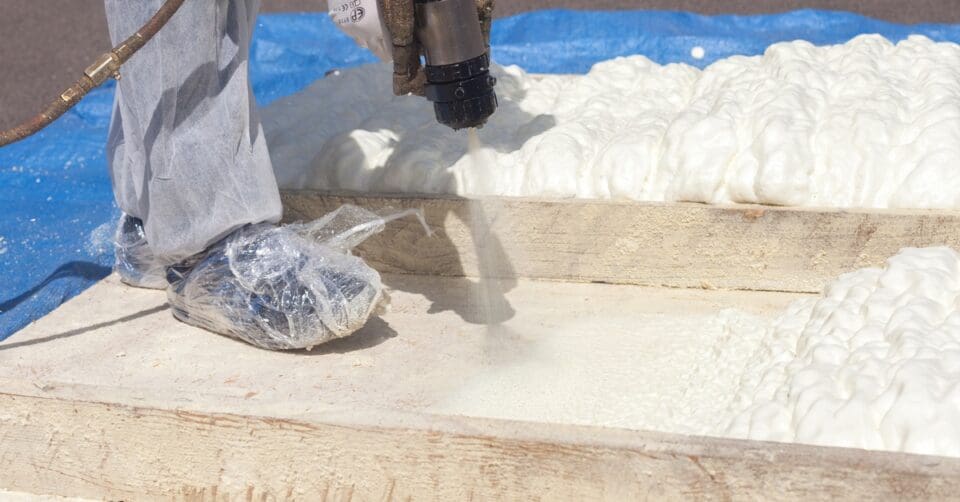
The most effective way to ensure a successful application is to keep your chemicals warm. Ideally, you should store drums in a heated warehouse until the morning of the job. Once they are on the rig, drum or band heaters are essential to maintain the manufacturer-recommended temperature, typically between 70 and 80 degrees Fahrenheit for most standard closed-cell foams.
Hose Temperature Management
You must also consider the hose’s temperature. Heated hoses are mandatory for winter work, but they are not miracle workers. If you lay a heated hose directly on frozen concrete or snow, the ground will suck the heat out faster than the electrical element can replace it. You should elevate hoses where possible, or insulate them from the frozen ground, to maintain a consistent fluid temperature all the way to the gun.
Substrate Preparation and Moisture Control
Understanding the substrate’s condition and ensuring it is adequately prepared are non-negotiable for successful adhesion, durability, and overall performance.
Thermal Shock Risks
The surface you are spraying onto matters just as much as the chemical itself. Spraying hot foam onto a freezing substrate creates thermal shock. The first pass of foam might not bond effectively because the cold surface steals the heat necessary for the exothermic reaction. This is particularly problematic with metal substrates or concrete, which hold the cold longer than wood.
Dew Point Monitoring
When warm foam comes into contact with a cold surface, condensation can form instantly. This microscopic layer of water creates a barrier between the foam and the substrate. Water reacts with the isocyanate to create urea and carbon dioxide, which can cause blistering and poor adhesion.
You need to continuously monitor the dew point. You should never spray if the substrate temperature is within 5 degrees of the dew point. In many cases, you will need to heat the spraying area.
Adjusting Application Techniques
Properly adjusting application techniques is critical to ensuring a successful outcome and the longevity of the applied material.
Flash Coating Method
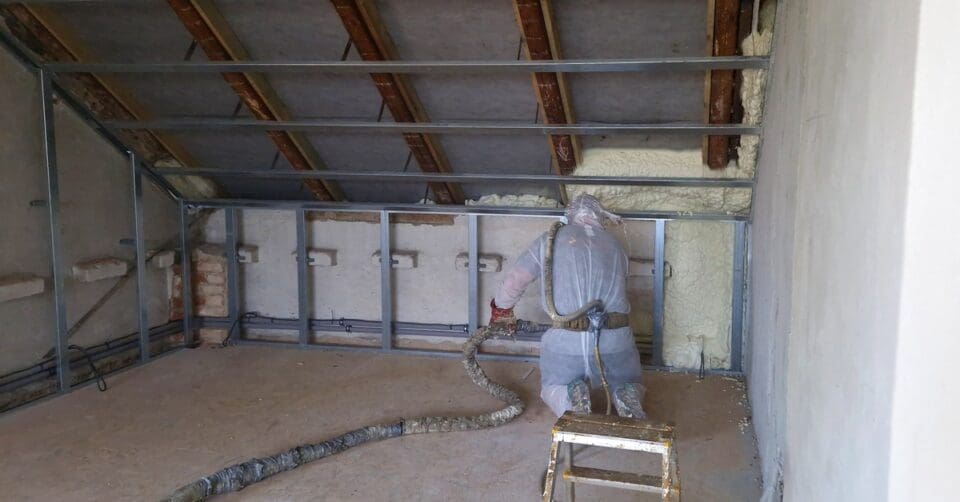
Winter spraying requires a change in your physical technique. The flash coating method becomes a valuable strategy in this scenario. This involves spraying a very thin layer of foam onto the substrate first. This initial layer will likely have a higher density and lower yield, but its primary purpose is to warm up the surface. Once this thin layer cures and forms a thermal break, you can proceed with your standard passes to achieve the required R-value.
Allowing Sufficient Cure Time
Patience is a necessary tool in your winter arsenal, as the cure times will be slower. You need to wait longer between passes to ensure the previous layer has cooled sufficiently and is firm enough to accept the next layer.
Winter Blend Formulations
Chemical manufacturers understand the difficulties of winter applications. That is why most suppliers offer specific winter blend formulations. These formulas contain different catalyst packages designed to kickstart the reaction faster at lower temperatures. They can help compensate for the environmental cold and allow the foam to cure properly, even when conditions are not ideal.
Ventilation Challenges
Safety protocols remain non-negotiable regardless of the season. In fact, winter adds a layer of complexity to safety. Ventilation is harder to manage when you are trying to keep the heat inside the building. You seal up the windows and doors to maintain temperature, but this traps the off-gassing chemicals.
You must use active ventilation systems that exhaust the air outside while bringing in fresh air. It is a balancing act, but worker safety and occupant safety cannot be compromised. Respiratory protection is mandatory for everyone in the work zone.
Equipment Wear and Preventive Maintenance
There is also the cost of equipment wear and tear. Cold starts are hard on generators and compressors, while hoses become stiff and prone to cracking. After all, a breakdown in sub-zero temperatures is not just an inconvenience; it can freeze your entire system and destroy your expensive heated hoses.
Keep the Crew Running
So, should you apply urethane insulation in winter? Yes, provided you respect the physics and chemistry involved. It is not business as usual. It requires a disciplined approach to temperature management, from the drum storage to the hose line and finally to the substrate itself.
Do not let the cold stop your business, but do not let it compromise your quality either! With the right preparation and knowledge, you can navigate the challenges of applying spray foam insulation during winter and keep your crews busy and profitable through the coldest months of the year.
Are you looking for reliable and urethane foam spray equipment built to tackle the toughest, coldest job sites with ease? At Spray Foam Systems, we provide heavy-duty solutions designed to perform under extreme conditions, ensuring you get the job done efficiently and effectively, no matter the challenge. Let us help you find the right equipment to keep your projects running smoothly!