


When homeowners compare insulation options, they often focus on energy savings, comfort, and long-term performance. One of the most important factors to understand is the open cell r value and how it affects a building’s ability to resist heat transfer. While insulation is only one part of an energy-efficient home, the right spray foam system can help improve comfort, reduce utility costs, and support better indoor air quality.
What Is Open Cell R Value?
The open cell r value measures how effectively open cell spray foam insulation resists heat flow. R-value is the standard rating used throughout the insulation industry to compare thermal performance.
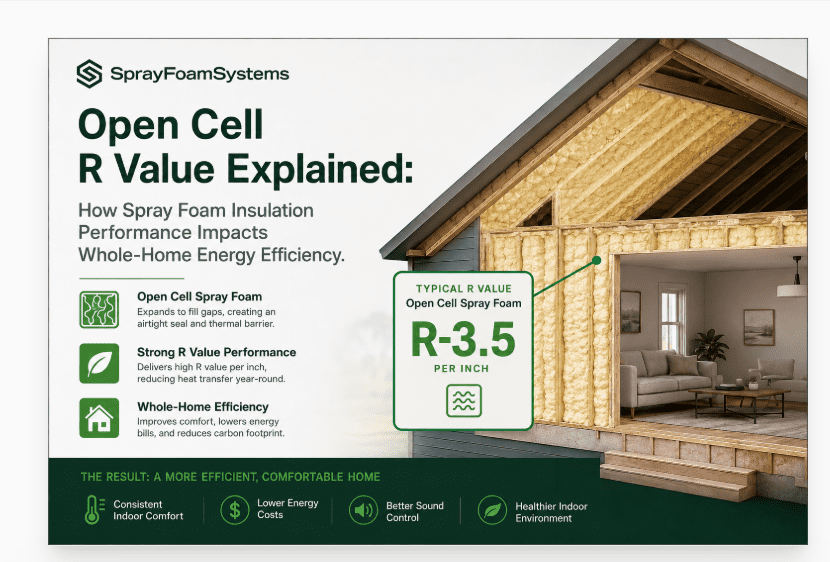
Open cell spray foam typically provides an R-value of approximately 3.5 to 4.0 per inch. Although this is lower than closed cell spray foam, open cell foam offers excellent air sealing capabilities that contribute significantly to overall energy efficiency.
Why Does R-Value Matter for Energy Efficiency?
R-value helps determine how much heat moves through walls, ceilings, and roof assemblies.
Higher insulation performance can help:
- Reduce heating and cooling demands
- Improve indoor comfort
- Minimize temperature fluctuations
- Lower monthly energy costs
- Support HVAC system efficiency
Understanding the open cell r value helps homeowners evaluate how insulation contributes to the overall performance of the building envelope.
How Do Spray Foam Insulation R Values Compare?
When comparing insulation materials, contractors often review various spray foam insulation r values to determine the best fit for a project.
Typical insulation comparisons include:
- Open cell spray foam: approximately R-3.5 to R-4.0 per inch
- Closed cell spray foam: approximately R-6.0 to R-7.0 per inch
- Fiberglass batts: approximately R-2.9 to R-3.8 per inch
- Cellulose insulation: approximately R-3.2 to R-3.8 per inch
While the open cell r value may be lower than closed cell foam, its ability to create a continuous air barrier often improves real-world energy performance.
How Does Open Cell Spray Foam Help Reduce Air Leakage?
Air leakage is one of the biggest causes of energy loss in homes.
Unlike traditional insulation materials, open cell spray foam expands after application to fill gaps, cracks, and penetrations. As a result, conditioned air stays inside while outdoor air remains outside.
Because of this air-sealing capability, many contractors consider the open cell r value alongside the foam’s ability to reduce unwanted airflow.
Does Open Cell Spray Foam Improve Roof Performance?
Yes. Open cell spray foam is frequently installed along roof decks and attic assemblies.
When applied correctly, it can:
- Create a conditioned attic space
- Reduce attic temperature swings
- Improve HVAC efficiency
- Enhance overall building comfort
Many homeowners notice that a properly insulated attic contributes significantly to whole-home energy savings. Therefore, the open cell r value plays an important role in roof insulation performance.
Can Open Cell Foam Improve Indoor Comfort?
Comfort involves more than temperature alone.
Open cell spray foam can help reduce drafts, improve temperature consistency between rooms, and limit unwanted outdoor air infiltration. In addition, its sound-dampening characteristics can help reduce noise transmission throughout the home.
These benefits work together with the open cell r value to create a more comfortable living environment.
Why Do Contractors Consider More Than Just R-Value?
Although R-value is important, insulation performance depends on several factors.
Contractors also evaluate:
- Air sealing performance
- Moisture management
- Building design
- Climate conditions
- HVAC system design
- Installation quality
For this reason, many professionals consider both the open cell r value and the overall building envelope when recommending insulation solutions.
How Does Open Cell Spray Foam Support Whole-Home Efficiency?
Whole-home energy efficiency requires multiple systems working together.
Open cell spray foam can help by:
- Reducing uncontrolled air movement
- Improving thermal performance
- Supporting HVAC efficiency
- Creating more consistent indoor temperatures
- Enhancing occupant comfort
As a result, homeowners often experience energy savings that extend beyond what insulation R-value numbers alone may suggest.
FAQs
What is the typical open cell r value?
The typical open cell r value ranges from approximately R-3.5 to R-4.0 per inch, depending on the specific foam formulation and application conditions.
How do spray foam insulation r values compare to traditional insulation?
Most spray foam insulation r values are competitive with or higher than fiberglass and cellulose insulation. Additionally, spray foam provides air sealing benefits that traditional insulation materials cannot match.
Why is open cell r value important when choosing insulation?
The open cell r value helps determine thermal resistance, but contractors also consider air sealing, moisture control, and overall building performance when selecting insulation for a project.
About Spray Foam Systems
Spray Foam Systems is the #1 spray foam rig builder and spray foam equipment supplier in the United States. Family-owned and proudly serving the industry since 2007, we operate from a 7-acre campus with over 80,000 square feet of dedicated working space in Greensboro, GA. With over 10,000 customers served over the last 18 years, we specialize in delivering high-quality turnkey spray foam systems, distributing top-tier equipment and supplies, and providing nationwide service and training to help contractors grow and succeed in the spray foam insulation and roofing markets.