


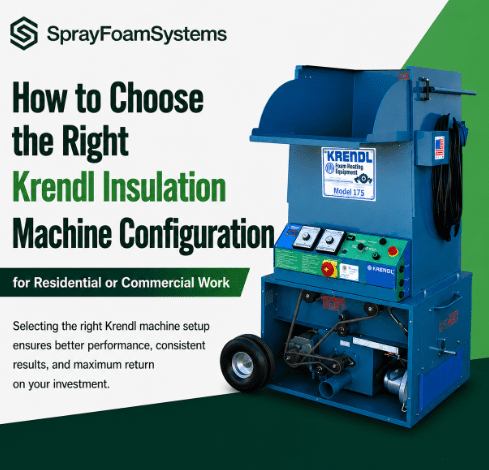
Choosing the right insulation machine setup can improve production speed, material flow, and overall jobsite efficiency. Residential and commercial projects often require different airflow capacities, hose lengths, and production levels, so selecting the proper equipment configuration is important for long-term success.
The right equipment package can also help contractors reduce downtime, improve installation consistency, and handle a wider range of insulation applications as business demands grow.
Residential Insulation Machine Configurations
Residential contractors usually need equipment that is compact, mobile, and easy to operate. Smaller jobsites, attic access points, and retrofit work often require an insulation machine that can move easily while still delivering reliable performance.
Residential setups commonly focus on:
- Easy transport and setup
- Consistent airflow
- Reliable material feed
- Efficient attic access
- Lower power requirements
Portable and compact systems are often ideal for contractors handling daily residential insulation projects.
Commercial Insulation Machine Setups
Commercial insulation work typically requires higher production output and longer hose runs. Schools, warehouses, office buildings, and apartment projects demand equipment that can operate continuously throughout the workday.
Commercial contractors often look for:
- Higher-capacity blowers
- Larger hopper systems
- Longer hose capability
- Increased airflow performance
- Continuous production efficiency
A properly configured insulation machine can help crews maintain steady production while reducing downtime on larger jobs.
Fiberglass vs Cellulose Equipment
Different insulation materials require different airflow and feed settings. Fiberglass applications usually require controlled airflow and smooth material handling, while cellulose projects often need higher production output and dense-pack capability.
Many contractors choose insulation machine systems that can handle both fiberglass and cellulose applications to increase versatility and job opportunities.
Portable vs Trailer-Mounted Equipment
Portable systems are commonly used for:
- Residential retrofit work
- Smaller crews
- Tight-access jobsites
- Contractors starting out
Trailer-mounted systems are often preferred for:
- Commercial projects
- Higher daily production
- Larger installation crews
- Full-time insulation businesses
A complete trailer setup can improve organization, hose management, and overall jobsite workflow.
Airflow and Hose Setup Considerations
Airflow performance plays a major role in installation quality and productivity. The proper hose size and blower configuration can help maintain consistent material delivery across different jobsite conditions.
Contractors should evaluate:
- Hose length requirements
- Airflow capacity
- Material consistency
- Dense-pack capability
- Daily production needs
Matching the insulation machine setup to the application helps crews work more efficiently while improving overall installation results.
Planning for Future Growth
Choosing an insulation machine that allows room for future expansion can help contractors grow without replacing equipment too quickly. Higher-capacity systems may allow businesses to take on larger residential and commercial projects over time.
Contractors should also consider equipment support, replacement parts availability, and technical service when selecting a machine configuration.
FAQs
What insulation machine works best for residential projects?
Compact and portable systems are often best for residential work because they are easier to transport and operate in smaller spaces.
Can one insulation machine handle fiberglass and cellulose materials?
Yes. Many systems are designed to handle both fiberglass and cellulose applications with adjustable airflow and feed settings.
Why is airflow important in an insulation machine?
Proper airflow helps maintain consistent material delivery and improves installation efficiency on both residential and commercial jobs.
About Spray Foam Systems
Spray Foam Systems is the #1 spray foam rig builder and spray foam equipment supplier in the United States. Family-owned and proudly serving the industry since 2007, we operate from a 7-acre campus with over 80,000 square feet of dedicated working space in Greensboro, GA. With over 10,000 customers served over the last 18 years, we specialize in delivering high-quality turnkey spray foam systems, distributing top-tier equipment and supplies, and providing nationwide service and training to help contractors grow and succeed in the spray foam insulation and roofing markets.