


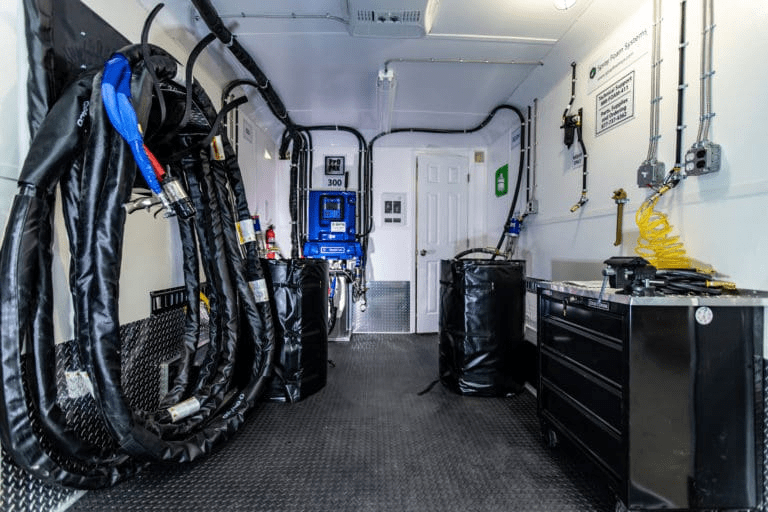
Growing a spray foam business means picking the right rig. The wrong choice can cost you in downtime, materials, and lost opportunity. Choosing the right Graco spray foam rig delivers power, speed, and consistency, which keeps your business efficient and profitable. This guide highlights the ProPAK 200, 300, and 400 so you can see which model best suits your work.
What each Graco spray foam rig offers
ProPAK 200
Graco designed the ProPAK 200 for contractors starting out or expanding into insulation. It uses the Graco E-20 Reactor and delivers up to 20 pounds per minute. In addition, it manages long hose runs and supports both open-cell and closed-cell foam. The generator and compressor are sized so small trucks or trailers can tow it with ease. With its heated hose and Fusion AP gun, the setup is simple, reliable, and cost-effective. (sprayfoamsys.com)
ProPAK 300
Stepping up to the ProPAK 300 gives you more speed and bigger job capacity. This rig features the Graco Reactor E-30 (or Reactor 2 E-30) and increases output to about 30 pounds per minute. In comparison to the 200, hose length rises to ~310 ft, and the onboard power system becomes more robust. With added storage space for gear, tools, and foam sets, it is a smart choice for contractors who handle both residential and commercial work. (sprayfoamsys.com)
ProPAK 400
The ProPAK 400 is engineered for high-volume production, making it ideal for roofing or industrial projects. It uses the Graco H-40 Reactor and pushes around 40 lbs per minute. Furthermore, hose lengths can extend beyond 400 ft depending on the setup. Built on heavy-duty trailers with higher GVWR, these rigs include powerful generators, twin or multiple transfer pumps, and larger compressors with upgraded air dryers. As a result, the 400 excels on demanding jobs that require nonstop output and consistent performance. (sprayfoamsys.com)
How to pick the right Graco spray foam rig
Consider project size, foam type, work site access, and budget before deciding.
For small homes, crawlspaces, or spray foam repairs, the ProPAK 200 offers the right balance of affordability and capacity. It is easier to maintain, carries a lower upfront cost, and handles tight spaces well.
On the other hand, contractors managing a mix of residential and commercial projects often find the ProPAK 300 more versatile. It provides greater hose reach, stronger power, and higher throughput while still being towable with a medium-duty truck.
Finally, for large roofing, industrial, or commercial jobs, the ProPAK 400 proves to be the strongest option. Its design tolerates heavy demand, moves material efficiently, and maintains consistent results when speed and reach are critical.
In addition, think about your power source. Some rigs are shore-powered, while others run on diesel. If reliable grid power is available, shore-powered models save fuel. However, diesel rigs work best for remote or rooftop projects. Hose length also matters since longer hoses create more heat loss unless the system is engineered to offset it.
Cost, maintenance & other hidden factors
Higher-capacity rigs cost more to purchase and maintain, and they also consume more fuel or electricity. Because larger rigs include more components—bigger pumps, generators, and hoses—there are more parts that require upkeep. As a result, training is essential, especially for the ProPAK 400, which demands skilled operators to manage heat, ratios, and safety.
In addition, warranty, service, and part availability should factor into your decision. Spray Foam Systems offers training, nationwide parts service, and dependable support, which helps reduce downtime. (sprayfoamsys.com)
Which rig fits your current and future needs
To narrow your choice, make a checklist:
- What’s your average foam usage per week or per job?
- How far do you need hose runs?
- Which power sources are available on your jobs (diesel or shore power)?
- How mobile does the rig need to be?
- What budget do you have for both purchase and operation (fuel, parts, maintenance)?
- What growth do you expect in 1–3 years?
If you anticipate steady small-scale work, the ProPAK 200 may be the smartest option. However, if you plan to expand into bigger projects, the ProPAK 300 or even the base 400 can deliver better long-term value.
FAQ
What is the life expectancy of a Graco spray foam rig?
When maintained correctly and cleaned on schedule, the reactor, hoses, pumps, and compressors can last for years. Trailer frames, generators, and other parts may require replacement or rebuild sooner, depending on workload and conditions.
Can one rig handle both open-cell and closed-cell foam applications?
Yes, every ProPAK model can spray both types. The differences come down to output, hose length, heating, and power systems. As the rig size increases, so do the demands on heat control and energy supply.
How hard is it to switch from a smaller rig to a larger one later?
Moving up to a larger system usually requires investing in a stronger reactor, bigger generator, longer hoses, and possibly a new trailer. Some equipment, such as guns and safety gear, may transfer. Planning ahead for compatibility and operator training makes the process smoother.
About Spray Foam Systems
Spray Foam Systems is the #1 spray foam rig builder and spray foam equipment supplier in the United States. Family-owned and proudly serving the industry since 2007, operating from a 7-acre campus with over 80,000 square feet of dedicated working space in Greensboro, GA. Over 10,000 customers served. We specialize in delivering high-quality turnkey spray foam systems, distributing top-tier equipment and supplies, and providing nationwide service and training to help contractors grow and succeed in the spray foam insulation and roofing markets.