


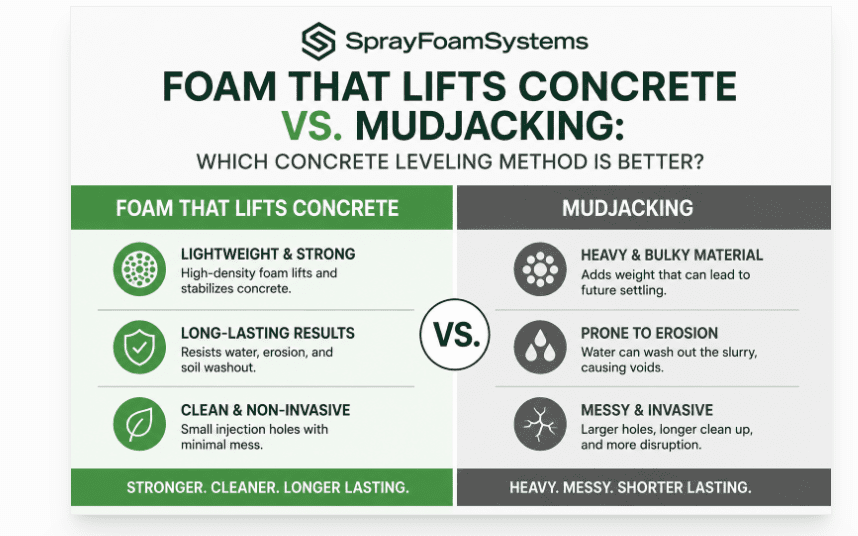
Uneven concrete creates safety hazards, reduces curb appeal, and can lead to more costly repairs if left untreated. Today, contractors have two primary options for restoring settled slabs: traditional mudjacking and foam that lifts concrete. Understanding how each method works can help contractors and property owners choose the best solution for long-lasting results.
What Is Foam That Lifts Concrete?
Foam that lifts concrete is a high-density polyurethane material injected beneath settled concrete slabs. As the material expands, it fills voids, stabilizes the underlying soil, and carefully raises the slab back to its original position.
Because polyurethane foam is lightweight and cures quickly, it has become a preferred solution for many residential, commercial, and industrial concrete repair projects.
How Does Mudjacking Work?
Mudjacking, sometimes called slabjacking, uses a slurry made from cement, sand, soil, and water that is pumped beneath a concrete slab. The pressure created by the slurry lifts the slab while filling empty spaces underneath.
Although mudjacking has been used successfully for many years, the heavier material can place additional weight on weak soils, which may contribute to future settlement in some conditions.
Foam That Lifts Concrete vs. Mudjacking: What Are the Biggest Differences?
Both methods restore uneven concrete, but there are several important differences contractors should consider.
Material Weight
One of the biggest advantages of foam that lifts concrete is its lightweight composition. Polyurethane foam adds very little weight beneath the slab while still providing excellent compressive strength after curing.
Mudjacking material is much heavier, increasing the load placed on already unstable soils.
Installation Speed
Polyurethane foam typically cures within minutes, allowing sidewalks, driveways, warehouse floors, and other surfaces to return to service much sooner.
Mudjacking generally requires a longer curing period before the repaired surface can support traffic.
Injection Hole Size
Foam injection requires only small holes, creating a cleaner, less invasive repair that is easy to patch and blend into the finished surface.
Mudjacking typically requires larger holes to accommodate the thicker slurry mixture.
Moisture Resistance
Unlike cement-based slurry, polyurethane foam resists water intrusion and will not wash away beneath the slab. This makes it an excellent option in areas exposed to frequent moisture or freeze-thaw cycles.
Where Is Foam That Lifts Concrete Used?
Contractors use foam that lifts concrete for a wide variety of applications, including:
- Sidewalks
- Driveways
- Garage floors
- Patios
- Pool decks
- Warehouse floors
- Industrial facilities
- Airport runways
- Municipal streets
- Loading docks
Its ability to both lift concrete and stabilize underlying soils makes polyurethane foam suitable for projects of nearly every size.
Why Are More Contractors Choosing Polyurethane Foam?
Many contractors continue to move toward polyurethane systems because they offer several advantages over traditional mudjacking, including:
- Faster project completion
- Minimal disruption to surrounding areas
- Smaller injection holes
- Lightweight yet durable support
- Excellent soil stabilization
- Long-term performance
These benefits help contractors complete projects more efficiently while providing customers with dependable concrete repair solutions.
Professional Geotechnical Foam Solutions from Spray Foam Systems
Spray Foam Systems supplies professional geotechnical foam products designed for concrete lifting, void filling, and soil stabilization. Whether you’re repairing sidewalks, warehouse floors, roadways, or commercial concrete surfaces, our geotechnical foam products deliver reliable performance for demanding applications.
FAQs
What is foam that lifts concrete?
Foam that lifts concrete is a polyurethane material injected beneath settled slabs to fill voids, stabilize soil, and raise concrete back to its original elevation with minimal disruption.
Is polyurethane better than mudjacking for concrete leveling?
For many projects, polyurethane foam offers advantages for concrete leveling, including faster curing, lighter weight, smaller injection holes, and improved moisture resistance compared to traditional mudjacking.
Can polyurethane foam be used for concrete leveling and lifting?
Yes. Contractors regularly use polyurethane foam for concrete leveling and lifting projects involving sidewalks, driveways, warehouse floors, patios, commercial buildings, and other concrete surfaces.
About Spray Foam Systems
Spray Foam Systems is the #1 spray foam rig builder and spray foam equipment supplier in the United States. Family-owned and proudly serving the industry since 2007, we operate from a 7-acre campus with over 80,000 square feet of dedicated working space in Greensboro, GA. With over 10,000 customers served over the last 18 years, we specialize in delivering high-quality turnkey spray foam systems, distributing top-tier equipment and supplies, and providing nationwide service and training to help contractors grow and succeed in the spray foam insulation and roofing markets.