


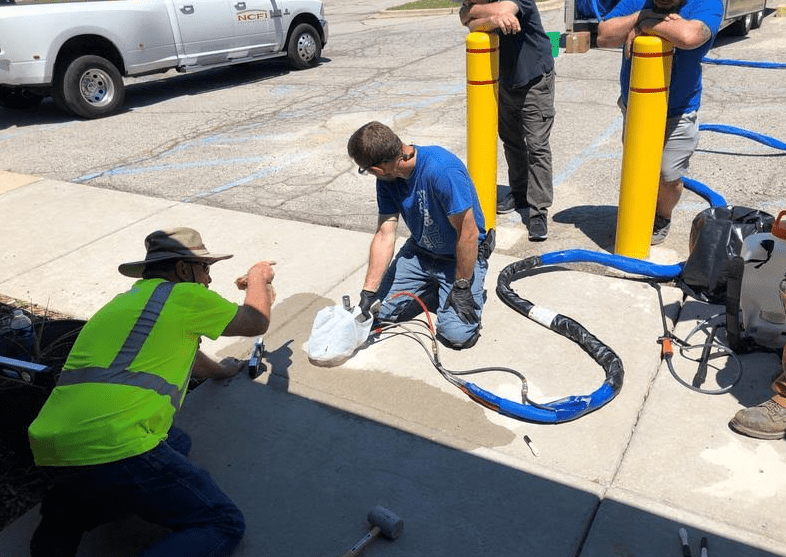
Concrete lifting and leveling costs play a major role in whether contractors decide to enter this growing market. As more property owners look for alternatives to full slab replacement, spray foam–based lifting has become a reliable, profitable solution. However, before investing in equipment, materials, and training, contractors must understand what drives concrete lifting and leveling costs and how spray foam systems support consistent results.
Concrete lifting and leveling costs vary based on job size, foam output, access conditions, and equipment capability. Smaller residential jobs often focus on driveways, sidewalks, and patios, while larger commercial projects include warehouse floors, loading docks, and industrial slabs. Spray foam lifting allows contractors to address both segments efficiently without demolition.
Spray foam concrete lifting relies on specialized coating rigs designed to deliver precise material ratios and controlled pressure. These systems inject high-density polyurethane foam beneath settled concrete, allowing slabs to lift evenly. Because the process requires accuracy, equipment selection directly impacts concrete lifting and leveling costs and long-term profitability.
Why Spray Foam Impacts Concrete Lifting and Leveling Costs
Spray foam technology reduces labor time, material waste, and surface disruption. Unlike mudjacking, foam cures quickly and adds minimal weight to soil. As a result, contractors complete more jobs per day, which helps offset upfront equipment investment and lowers overall concrete lifting and leveling costs per project.
Additionally, foam expands predictably when applied with the correct proportioner and hose setup. This control minimizes callbacks and repairs, which protects margins and customer satisfaction.
Equipment Considerations for Concrete Lifting Applications
Concrete lifting rigs designed for foam applications use hydraulic-driven proportioners paired with heated hose assemblies. These systems maintain consistent temperature and pressure, which ensures proper foam expansion under slabs. Output control is essential, especially when addressing sensitive areas like interior floors or decorative concrete.
Many contractors entering the market choose dedicated concrete lifting rigs rather than adapting insulation equipment. Purpose-built systems support repeatable results, faster setup, and better material control, all of which help manage concrete lifting and leveling costs as job volume increases.
Material Usage and Job Pricing Factors
Material usage directly affects concrete lifting and leveling costs. Factors such as slab thickness, void size, soil conditions, and lift height all influence foam volume. Accurate estimates depend on experience and proper equipment calibration.
Spray foam allows contractors to price jobs based on foam volume and access complexity rather than square footage alone. This approach improves pricing accuracy and protects profit margins, especially on uneven or partially settled slabs.
Training, Safety, and Operational Expenses
Beyond equipment and materials, contractors must factor in training, safety gear, and jobsite preparation. Foam lifting requires understanding expansion rates, injection patterns, and slab behavior. Proper training reduces mistakes that can increase concrete lifting and leveling costs over time.
Personal protective equipment, including respirators, gloves, and eye protection, remains essential on every job. Safe handling practices protect crews and ensure compliance with industry standards.
Contractors considering entry into concrete lifting should speak with Spray Foam Systems to review equipment options, material selection, and system configurations that match their business goals.
FAQs
What affects concrete lifting and leveling costs the most?
The biggest factors include foam volume, slab size, access conditions, equipment capability, and labor time.
Is spray foam concrete lifting profitable for new contractors?
Yes. With the right equipment and training, spray foam lifting offers strong margins due to fast turnaround times and growing demand.
Do I need specialized equipment for concrete lifting jobs?
Yes. Dedicated concrete lifting rigs provide better control, consistency, and efficiency than modified insulation equipment.
About Spray Foam Systems
Spray Foam Systems is the #1 spray foam rig builder and spray foam equipment supplier in the United States. Family-owned and proudly serving the industry since 2007, we operate from a 7-acre campus with over 80,000 square feet of dedicated working space in Greensboro, GA. With over 10,000 customers served over the last 18 years, we specialize in delivering high-quality turnkey spray foam systems, distributing top-tier equipment and supplies, and providing nationwide service and training to help contractors grow and succeed in the spray foam insulation and roofing markets.