


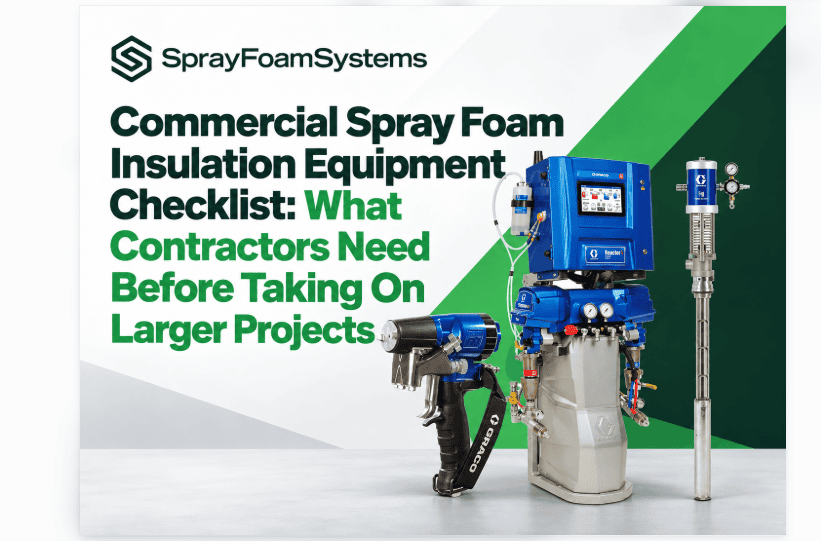
Taking on larger projects requires more than just having a proportioner and spray gun. Contractors moving into commercial spray foam insulation work need a complete setup that can support longer spray times, higher material demand, and larger jobsite requirements.
Before starting a commercial project, it is important to make sure the entire rig is ready to support consistent production.
Commercial Spray Foam Insulation Equipment Checklist
A reliable commercial spray foam insulation setup should include more than the basic spray equipment. Contractors should review the full system before taking on larger work.
Proportioner
The proportioner is the core of the spray foam system. Contractors should make sure it can provide the pressure, temperature control, and output needed for the size of the project.
For larger jobs, equipment capacity becomes especially important because the system may need to operate for longer periods.
Heated Hose
Adequate heated hose length gives applicators more flexibility on larger jobsites.
Contractors should inspect hose condition, connections, insulation, and heat performance before beginning a commercial spray foam insulation project.
Transfer Pumps
Transfer pumps move ISO and resin from the drums to the proportioner.
Before a project begins, crews should inspect pumps, air lines, fittings, and seals. Keeping common replacement parts in the rig can also help prevent unnecessary downtime.
Spray Gun and Spare Parts
The spray gun should be cleaned and maintained before each larger project.
Contractors should also carry commonly used replacement parts such as:
- Mixing chambers
- Side seals
- O-rings
- Screens
- Grease
- Cleaning tools
Having these parts available can help crews quickly address common issues on the job.
Generator, Compressor, and Air Dryer
Larger projects can place more demand on the supporting equipment inside the rig.
The generator should have enough capacity to operate the proportioner and other equipment at the same time. The air compressor should provide sufficient pressure and airflow, while the air dryer should help keep moisture out of the compressed air system.
For commercial spray foam insulation, these components should all be inspected before the rig leaves for the jobsite.
Material Handling and Jobsite Supplies
Commercial projects often require more material and longer spray times.
Contractors should make sure drums, transfer pumps, hoses, fittings, and connections are organized and easy to access. The rig should also include the maintenance supplies and tools needed for routine service during the project.
Personal protective equipment should also be ready before work begins. This may include respiratory protection, protective suits, gloves, eye protection, ventilation equipment, and other safety equipment required for the application.
Carry Spare Parts to Reduce Downtime
Downtime can become expensive when a crew is working on a larger project.
Contractors preparing for commercial spray foam insulation work should carry commonly used filters, screens, seals, fittings, gun parts, and maintenance supplies.
Keeping these items in the rig can make it easier to handle minor equipment issues without stopping the project for an extended period.
Inspect the Rig Before the Project Starts
Preventive maintenance should be completed before arriving on a larger jobsite.
Contractors should inspect hoses, fittings, filters, screens, heaters, fluid pressures, transfer pumps, the spray gun, compressor, and air dryer. Addressing worn or damaged parts ahead of time can help reduce unexpected equipment problems.
A well-organized rig also makes daily inspections and routine maintenance easier throughout the project.
Make Sure Your Equipment Can Support Larger Jobs
Moving into commercial spray foam insulation work means the entire equipment system needs to be ready for increased production demands.
The right proportioner, heated hose, transfer pumps, power supply, air system, spare parts, and maintenance plan can help contractors work more efficiently and reduce avoidable downtime.
Spray Foam Systems can help contractors evaluate spray foam rigs, proportioners, parts, service, and equipment options for larger projects.
Ready to prepare your equipment for larger spray foam projects? Explore Spray Foam Systems equipment and rig options built to support growing insulation operations.
FAQs
What equipment is needed for commercial spray foam insulation?
A complete setup typically includes a proportioner, heated hose, spray gun, transfer pumps, generator or electrical supply, air compressor, air dryer, PPE, and maintenance supplies.
Do contractors need a different spray foam rig for larger projects?
Not always. However, contractors should make sure their current rig has enough output, power, hose length, air supply, and supporting equipment for the size of the project.
What spare parts should contractors carry on larger spray foam jobs?
Contractors should consider carrying filters, screens, seals, O-rings, fittings, gun components, cleaning tools, and other commonly used replacement parts.
About Spray Foam Systems
Spray Foam Systems is the #1 spray foam rig builder and spray foam equipment supplier in the United States. Family-owned and proudly serving the industry since 2007, we operate from a 7-acre campus with over 80,000 square feet of dedicated working space in Greensboro, GA. With over 10,000 customers served over the last 18 years, we specialize in delivering high-quality turnkey spray foam systems, distributing top-tier equipment and supplies, and providing nationwide service and training to help contractors grow and succeed in the spray foam insulation and roofing markets.