


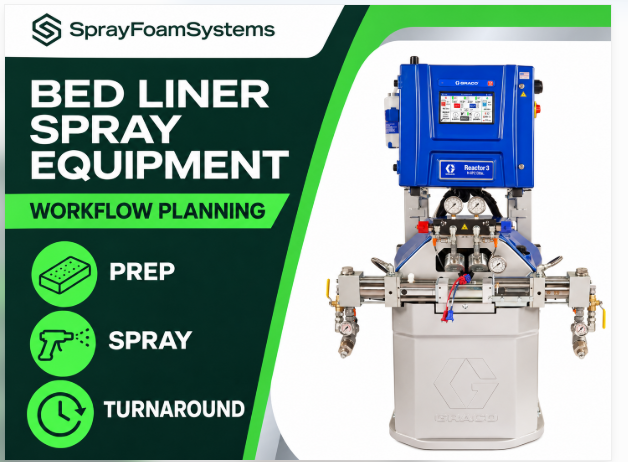
Your bed liner spray equipment is one part of your daily job capacity. Prep, spray time, cure requirements, and final checks all shape how many trucks your shop can complete. A clear plan helps your crew set realistic goals and give customers clear pickup times.
Plan the Full Job Before You Set a Daily Goal
First, map each step from truck drop-off to release. Include the bed check, cleaning, surface prep, masking, equipment startup, spraying, inspection, and cleanup. Then add any required primer, flash, or cure time for the coating you use.
Next, track which steps need a worker and which steps occupy a bay. These are different limits. A coating may need little hands-on work while it cures, yet the truck may still occupy space that the next job needs.
Match Bed Liner Spray Equipment to Your Workflow
Choose bed liner spray equipment around your coating, work volume, and shop layout. For heated plural-component coatings, review the proportioner, feed pumps, heated hose, gun, air supply, and power as one system. Each part must meet the coating and equipment makers’ requirements.
- Material delivery: Match the required ratio, heat, pressure, and flow.
- Gun setup: Choose compatible parts for the coating and finish.
- Hose reach: Allow access around the truck within equipment limits.
- Air and power: Account for all equipment that runs at the same time.
- Service needs: Plan access to wear parts, tools, and routine care.
However, a higher-output machine alone will not raise your daily capacity if prep holds up each job. Time your current process first. That shows whether you need more spray output, more prep support, or a better use of space.
Build a Repeatable Prep Stage
Start with a bed inspection before you promise a finish time. Rust, old coatings, damage, and added accessories can change the scope. Follow the coating maker’s instructions for cleaning, surface profile, and any primer needs. Also, allow for required drying and recoat windows.
Then stage the tools and supplies for each job. A ready prep cart can reduce trips across the shop. Keep sanding dust and prep debris away from ready-to-spray surfaces. Where the facility allows, use separate prep and spray areas with suitable controls.
Count Setup and Reset Time in the Spray Stage
Spray time includes more than time with the trigger pulled. Add material checks, warmup, equipment checks, and any required test spray. Before coating the truck, confirm that the system operates within the specified limits.
After spraying, allow time for gun care, inspection, and the reset between jobs. Follow the equipment manual for shutdown and service tasks. Also, plan the spray area’s ventilation, access controls, and protective equipment around the coating’s safety requirements.
Separate Cure Time from Customer Pickup Time
A fast-setting coating does not automatically mean the truck is ready for cargo. Follow the coating maker’s instructions for handling, movement, and return to service. Use those limits when planning masking removal, final checks, and customer release.
Before pickup, check coverage, edges, finish, and specified thickness using the appropriate method. Then give the customer clear care instructions. Explain when they may load the bed, wash the truck, or place it back into normal use.
Find the Stage That Limits Daily Capacity
For a simple planning example, assume an eight-hour shift provides six usable production hours after planned downtime. The figures below are sample shop timings, not coating specifications or promised production rates.
- Prep: 90 minutes per truck at one station allows four trucks.
- Spray and reset: 45 minutes per truck at one station allows eight trucks.
- Finish and release checks: 60 minutes per truck at one station allows six trucks.
With separate staff and enough space, prep limits this example to a theoretical four trucks per day. Shared workers, cure-space limits, and the time needed to finish the last truck can lower that count. Therefore, build a timed schedule before you book all four slots.
Use Actual Job Records to Plan Growth
Finally, record stage times, material use, delays, and rework across several jobs. Compare similar bed sizes and conditions. These records help you decide whether to add a prep worker, change the layout, or expand your bed liner spray equipment setup.
Explore bed liner spray equipment from Spray Foam Systems. Contact SFS to discuss your coating requirements, available utilities, and daily workload before choosing a complete setup.
FAQs
1. How many truck beds can a shop spray each day?
Daily output depends on prep time, staffing, spray time, cure requirements, and available space. Track the full process to find the stage that limits your schedule.
2. Will a larger spray machine increase daily capacity?
It may help when material delivery limits production. However, it will not resolve delays caused by prep, shared labor, or occupied bays. Review those limits before choosing an upgrade.
3. How soon can a customer use a freshly coated truck bed?
Use the coating manufacturer’s return-to-service instructions. Handling time, pickup time, and permission to load cargo may differ. Give the customer the requirements for the specific coating applied.
About Spray Foam Systems
Spray Foam Systems is the #1 spray foam rig builder and spray foam equipment supplier in the United States. Family-owned and proudly serving the industry since 2007, we operate from a 7-acre campus with over 80,000 square feet of dedicated working space in Greensboro, GA. With over 10,000 customers served over the last 18 years, we specialize in delivering high-quality turnkey spray foam systems, distributing top-tier equipment and supplies, and providing nationwide service and training to help contractors grow and succeed in the spray foam insulation and roofing markets.